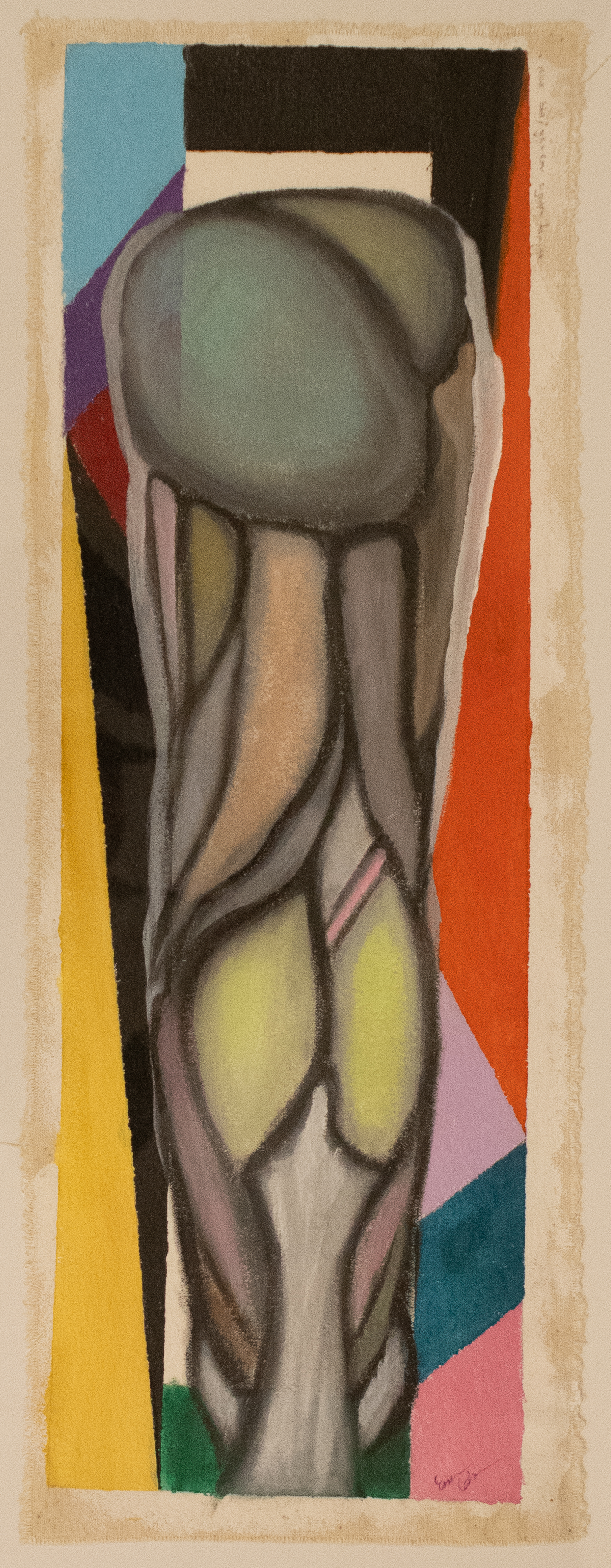
Acrylic painting of posterior leg view to capture the different muscles.
The image is of two pairs of drawn hands reaching out to each other over a black background, palms up. The pair on the left is clean and unhurt, while the pair on the right is hurt and bandaged. The hands have thread stitched between them as a illustration of the two being pulled together.
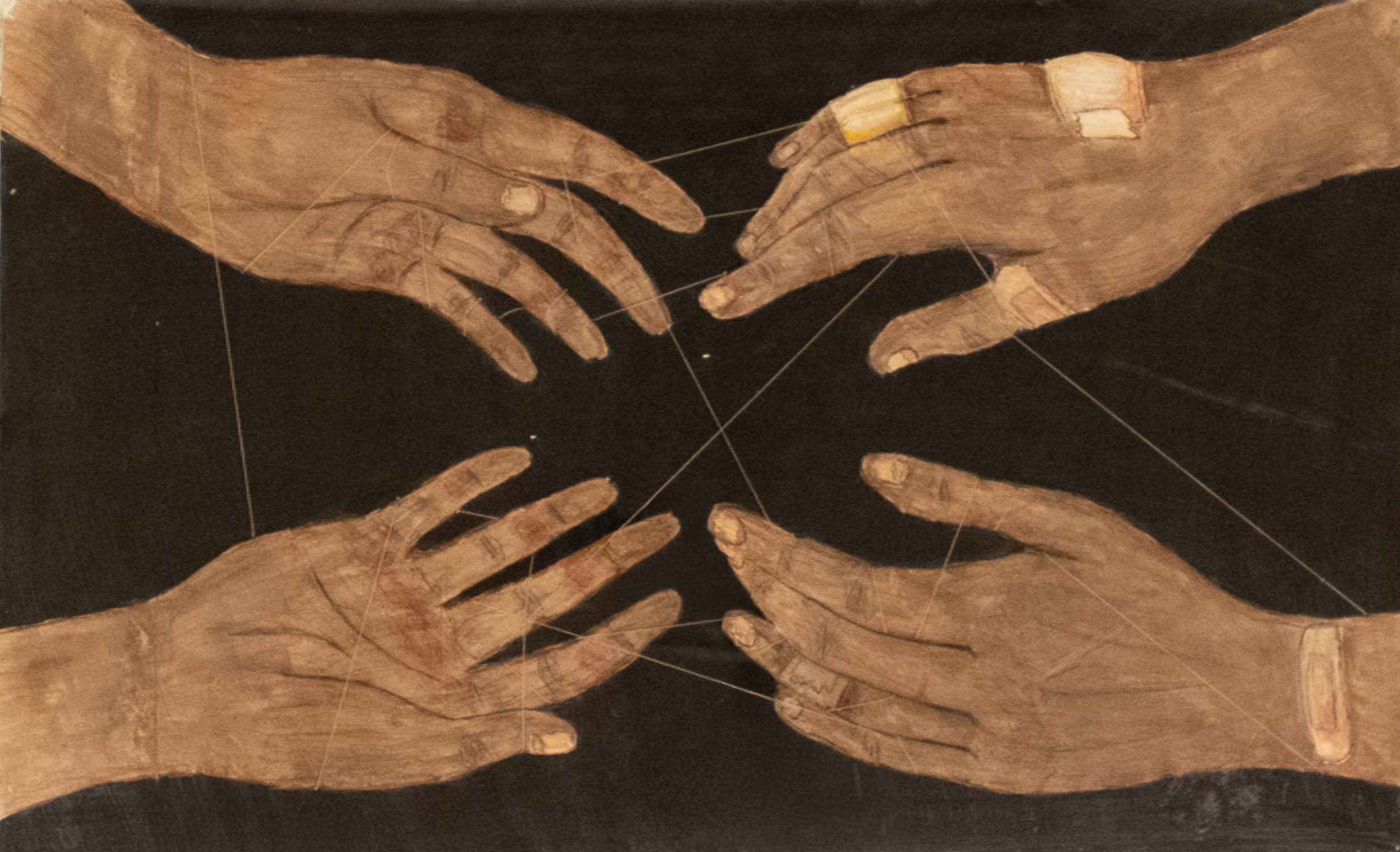
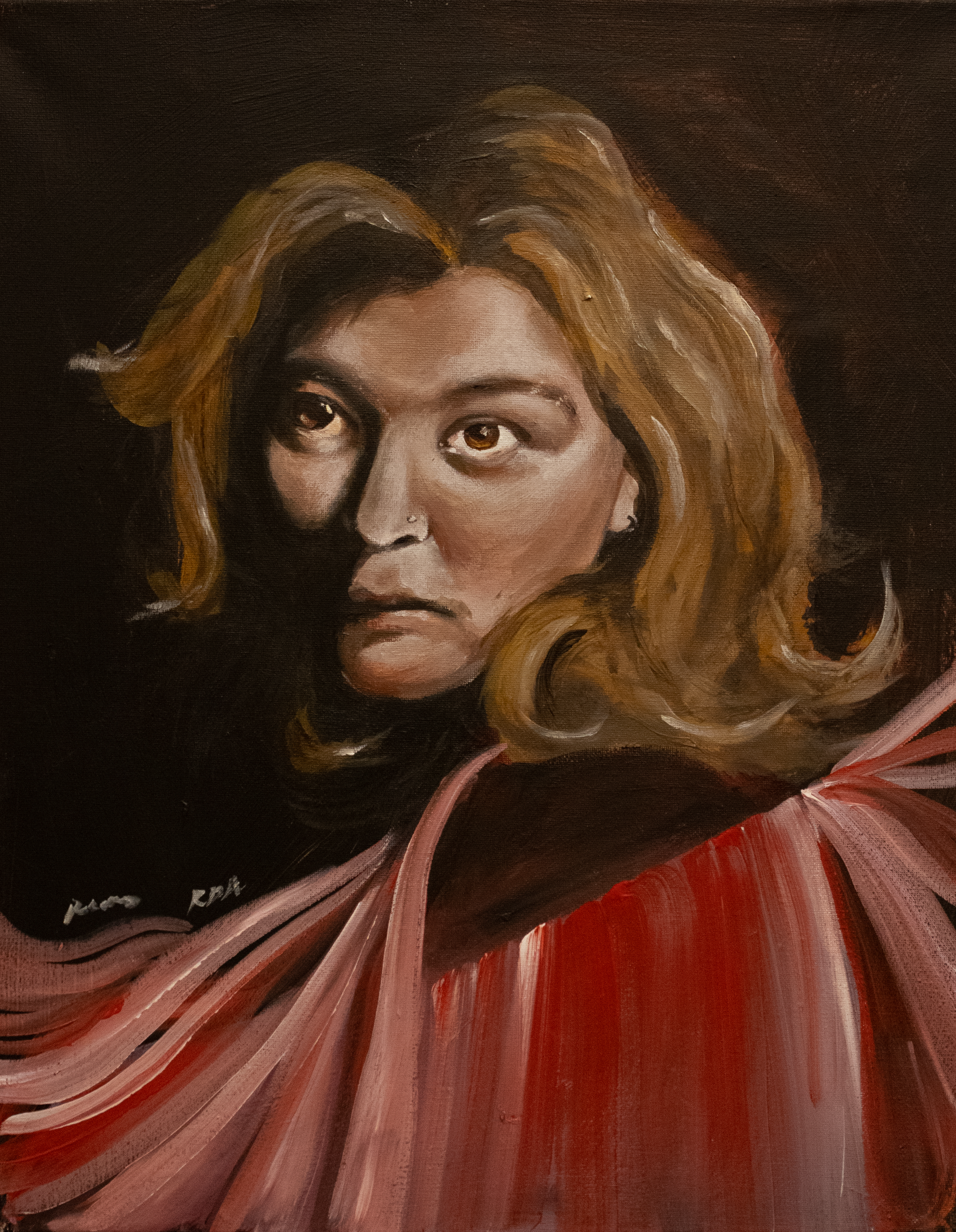
Figure of a woman in a dark background with a directional light from an angle. This is a symbol of all of the hardships she has went through but also having a light on the new outcomes the future holds after pushing through. The red abstract is a symbol of the pain into something poetic that will be something she carries for the rest of her life.
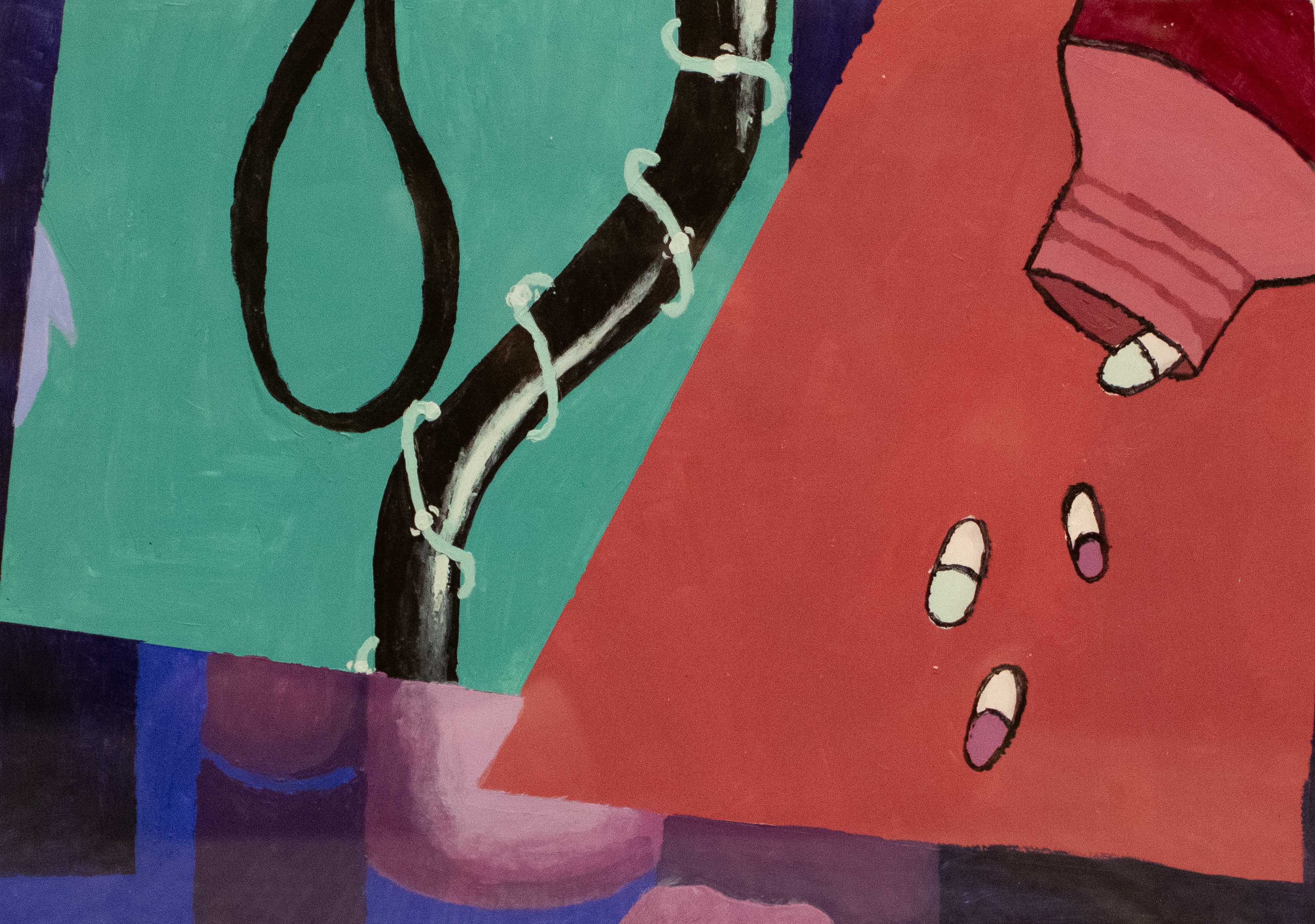
There is a pink bottle pouring out pink and green pills on a pink backdrop that is cutoff my a can on a green backdrop wrapped in small green lights, at the bottom of the painting there is a shelf of pill bottles that is barely visible in blue and purple.
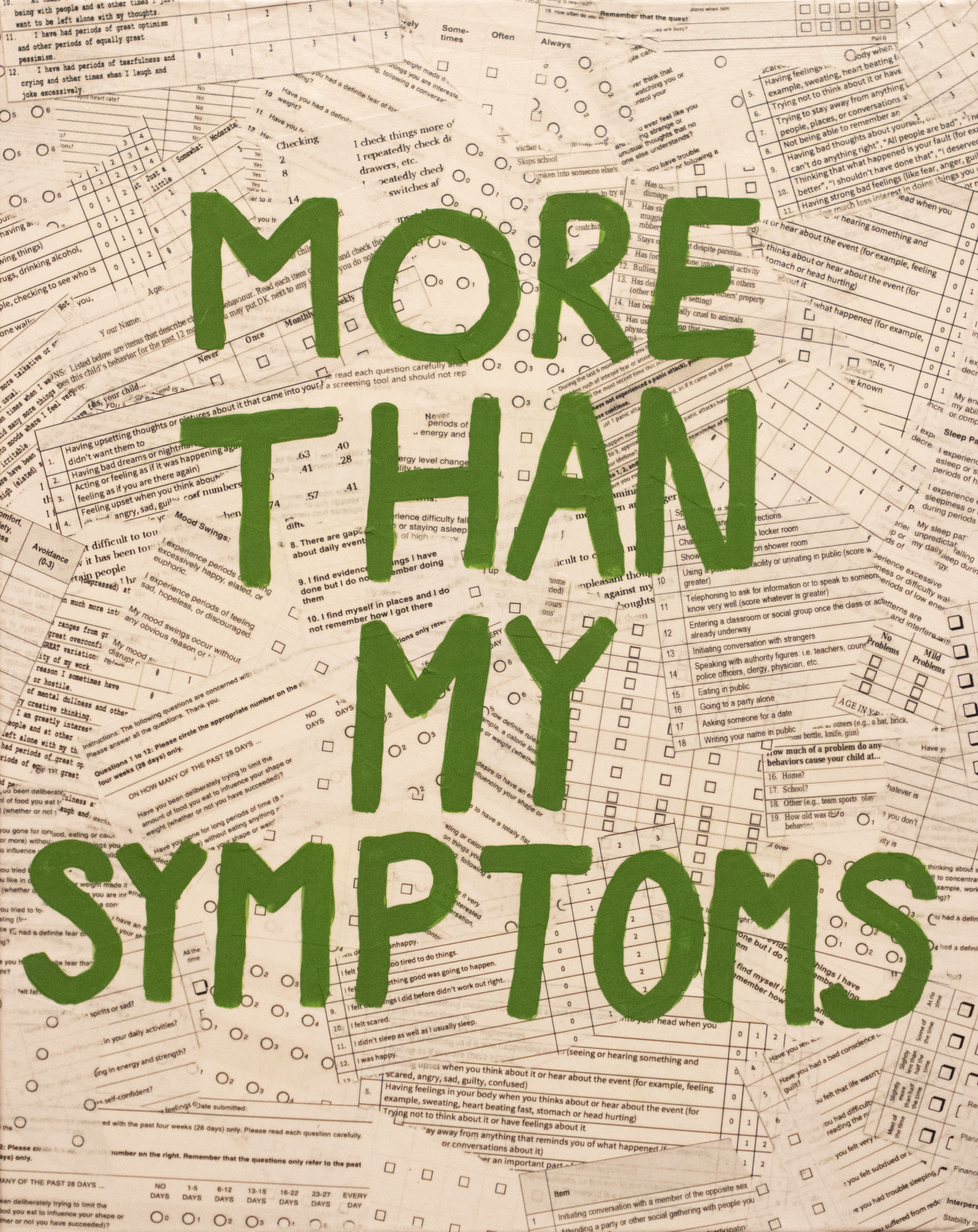
Paper-mache collage of black-and-white screening questionnaires for various clinical diagnoses with green painted words reading, “MORE THAN MY SYMPTOMS” overtop.
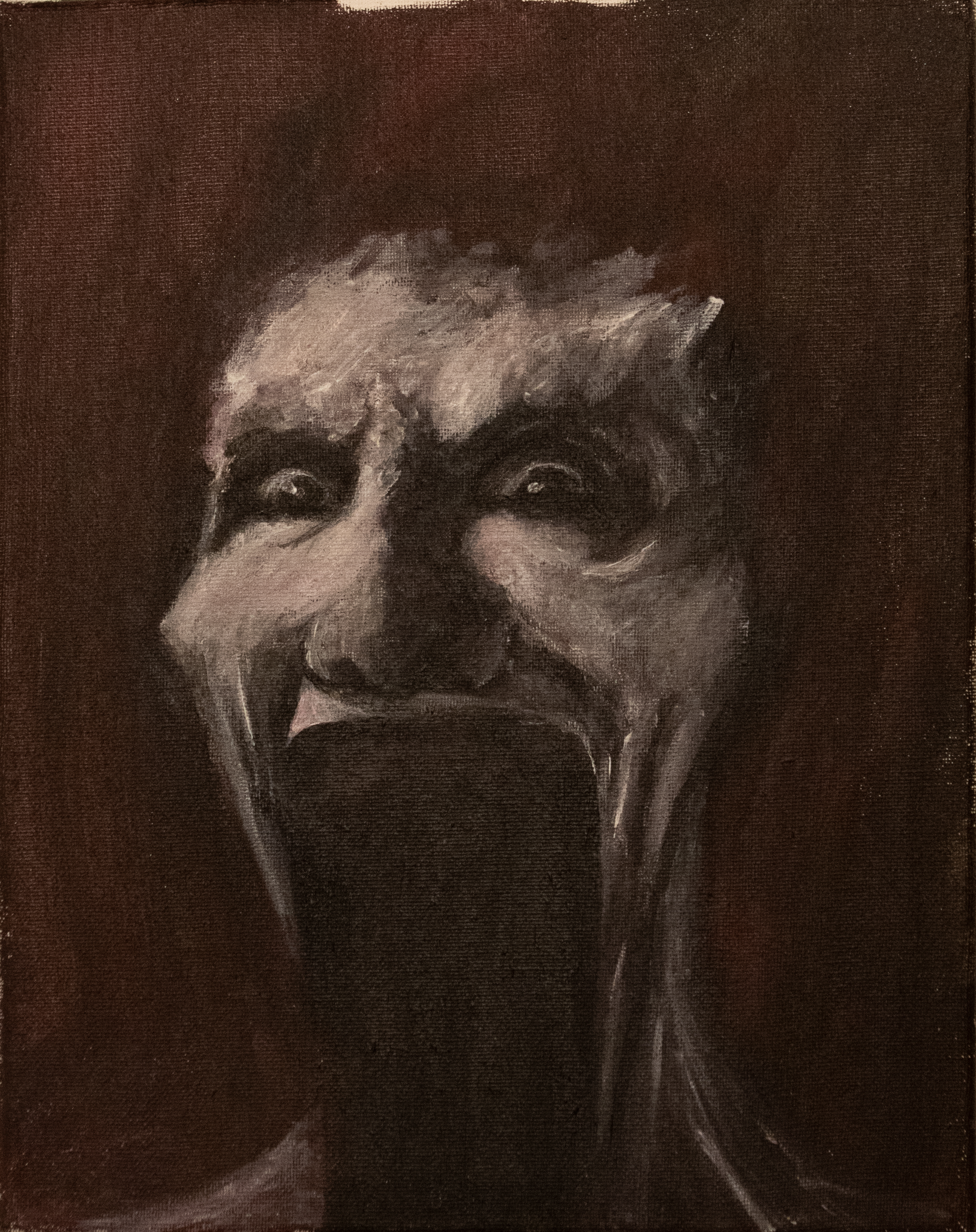
An agonized figure with an elongated mouth emerging from a dark background.
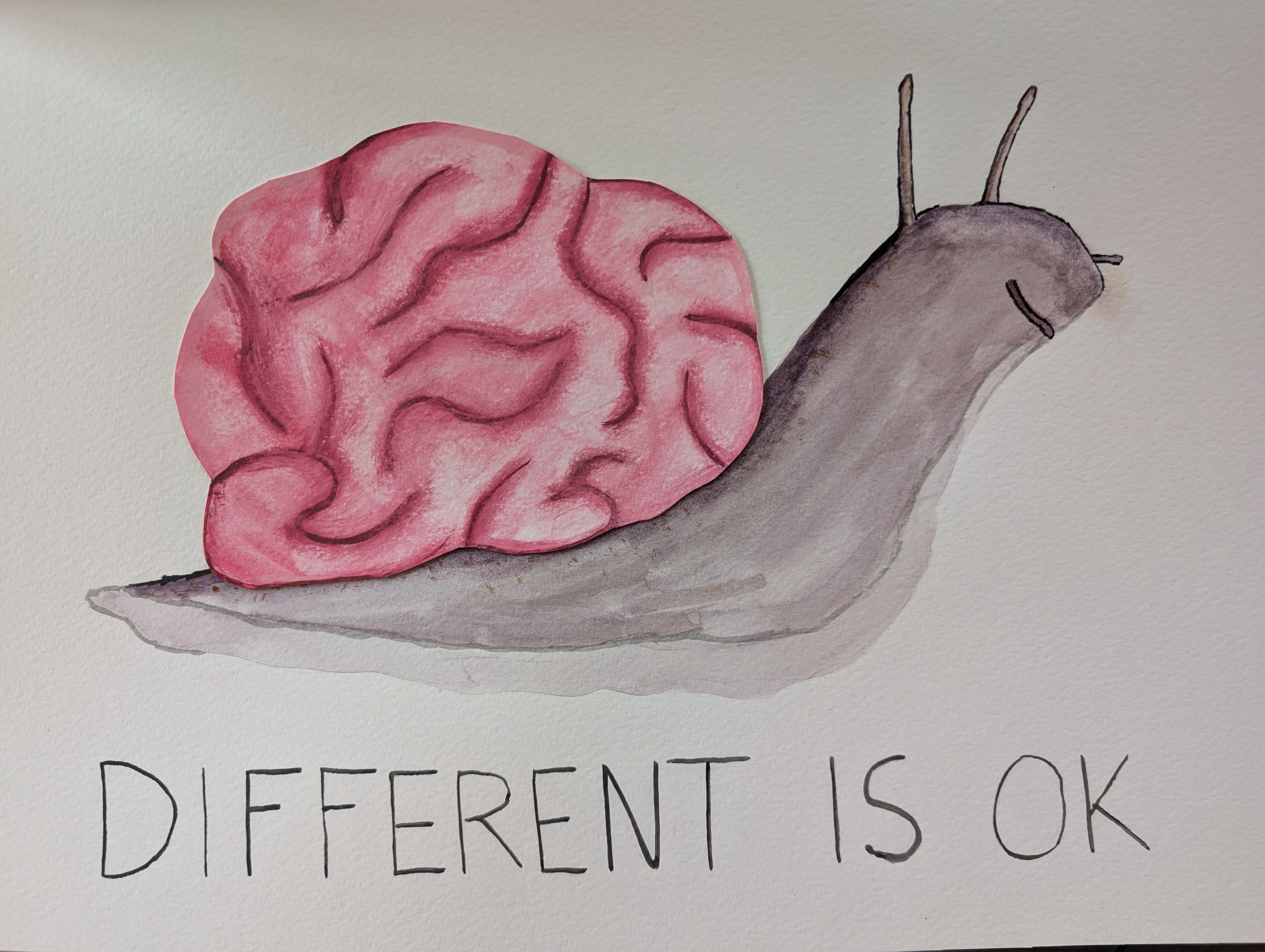
Watercolor painting of purple snail with a brain as the shell. Text below the drawing says "Different is OK"
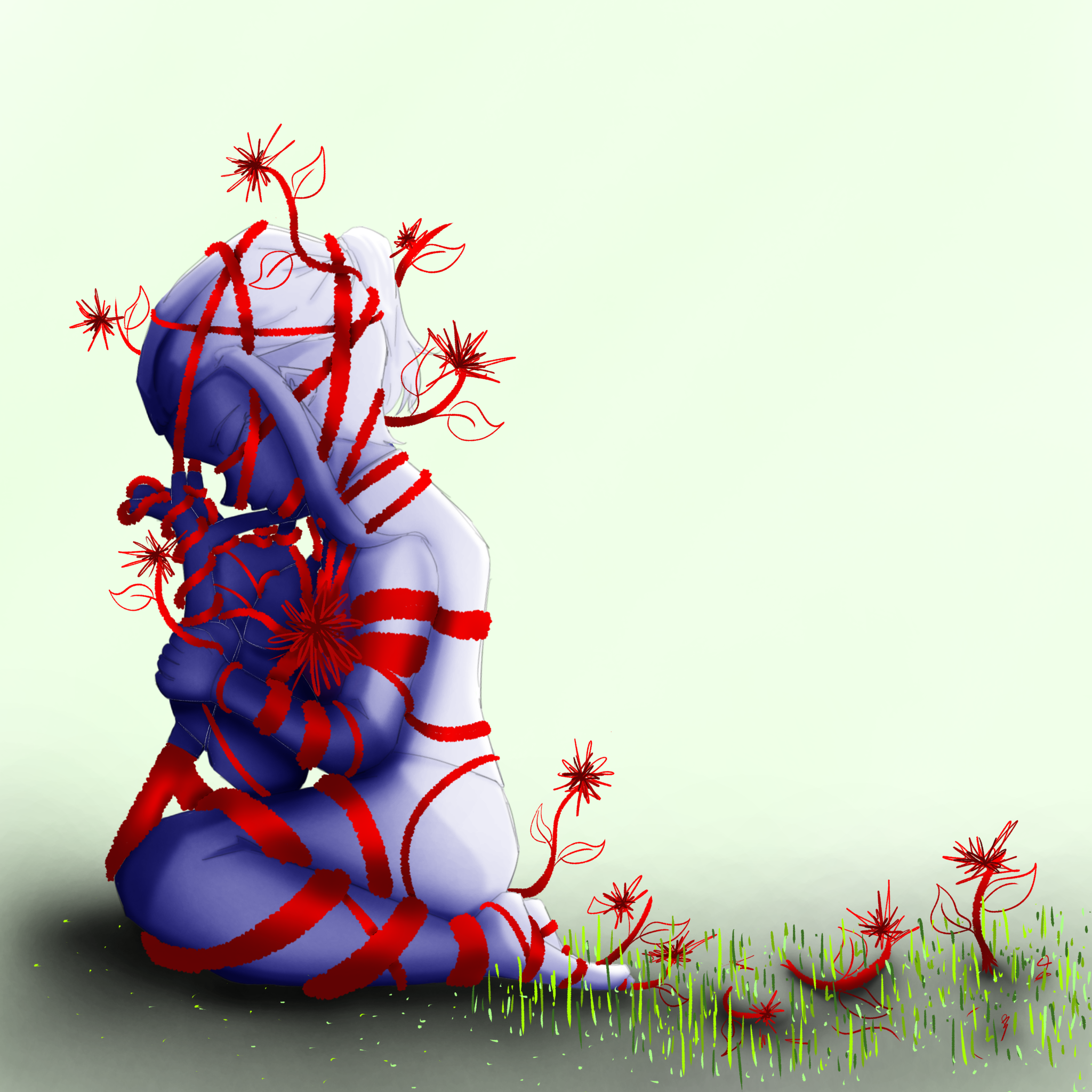
A kneeling female figure rendered in a blue ombre is clutching an enlarged human heart (also rendered in blue) as red vines sprout from the various openings of the heart and wrap around the figure, intertwining them together. Red flowers and leaves sprout from some of the ends of the vines as well as over the figure's chest where her heart should be. a trail of broken red vines trail the figure as green grass sprouts behind her.
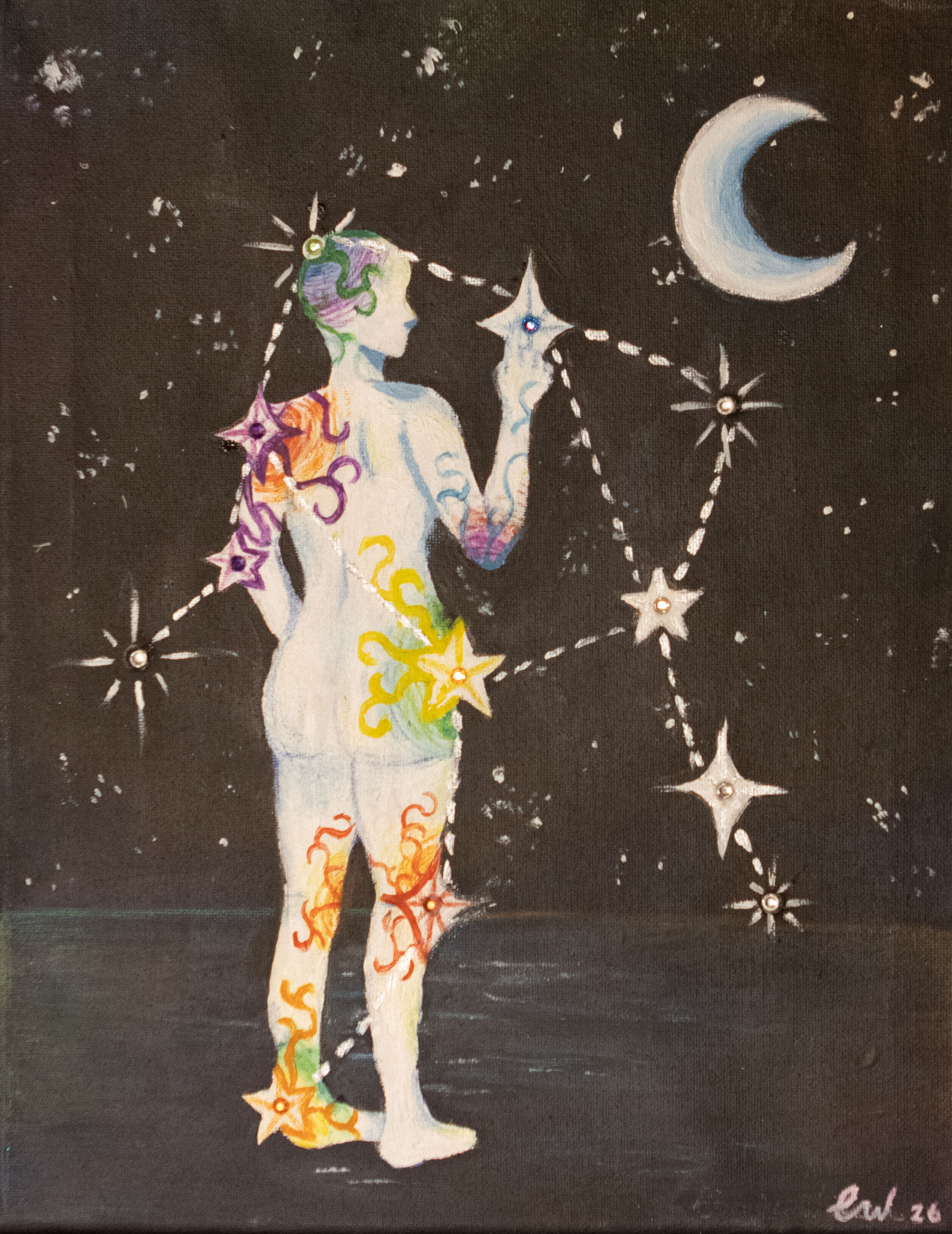
A white, featureless figure stands partially turned away from the viewer, they are reaching their left hand up to touch a large white star. There are a total of 12 large, white stars, with 6 of them intersecting with the figure's body. The stars are connected by silver, dashed lines, revealing the constellation "Ophiuchus". The figure's body has swirls in various rainbow colors on their head, lower abdomen, and various joints, seemingly emerging from the stars connected to their body. Each of the stars that intersect with the figure has a rhinestone in the center that matches the color of the swirls near it. The stars that aren't on the body each have one silver rhinestone in their center. The canvas is black, with the ground appearing to be water and a rainbow ombre along the edges of the canvas. In the background, there are various smaller white stars, and a large, crescent moon.
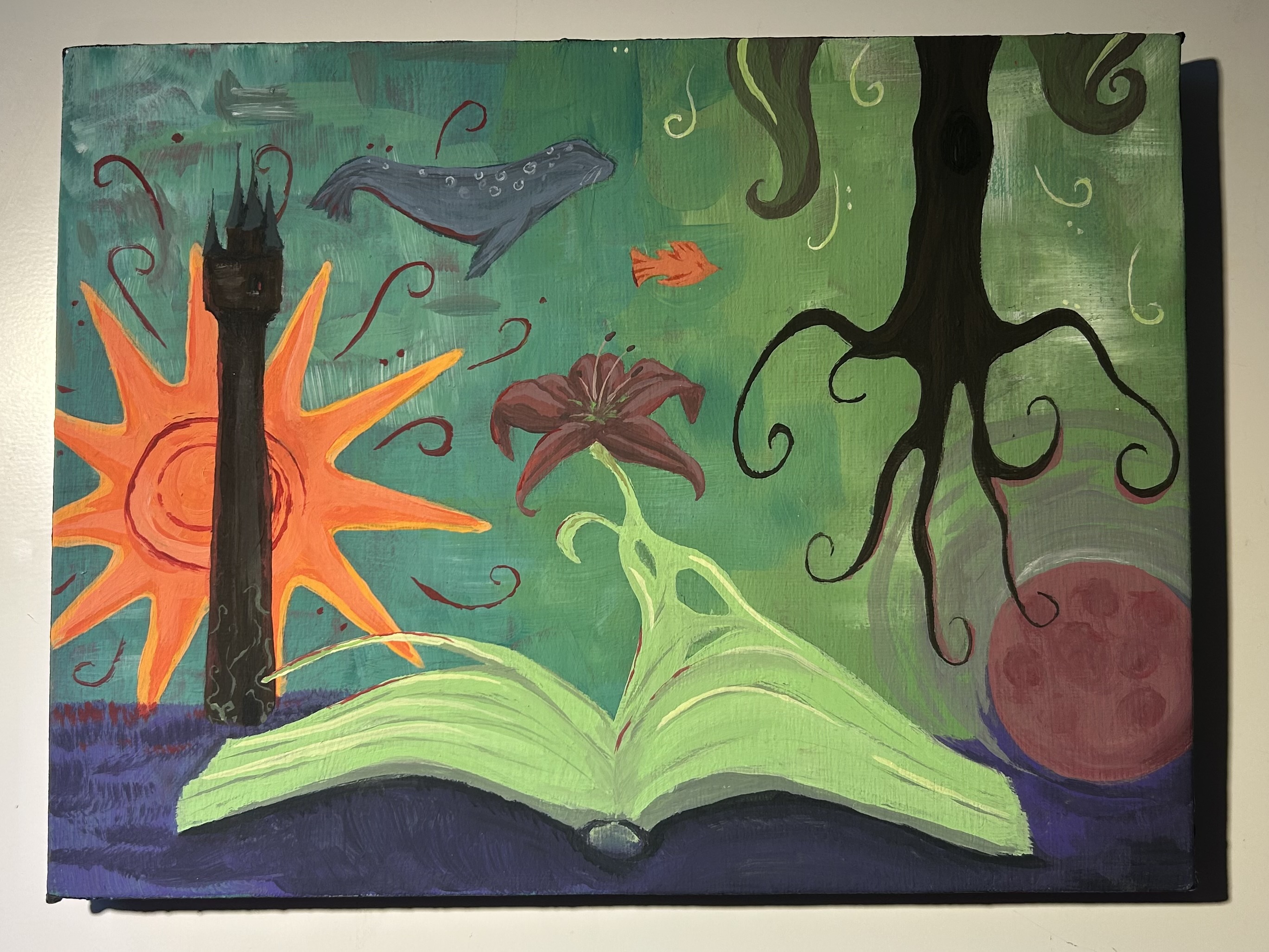
A book with no words and a Lily flower growing out of the pages, along with an abstract scene of planets, sea life and nature.
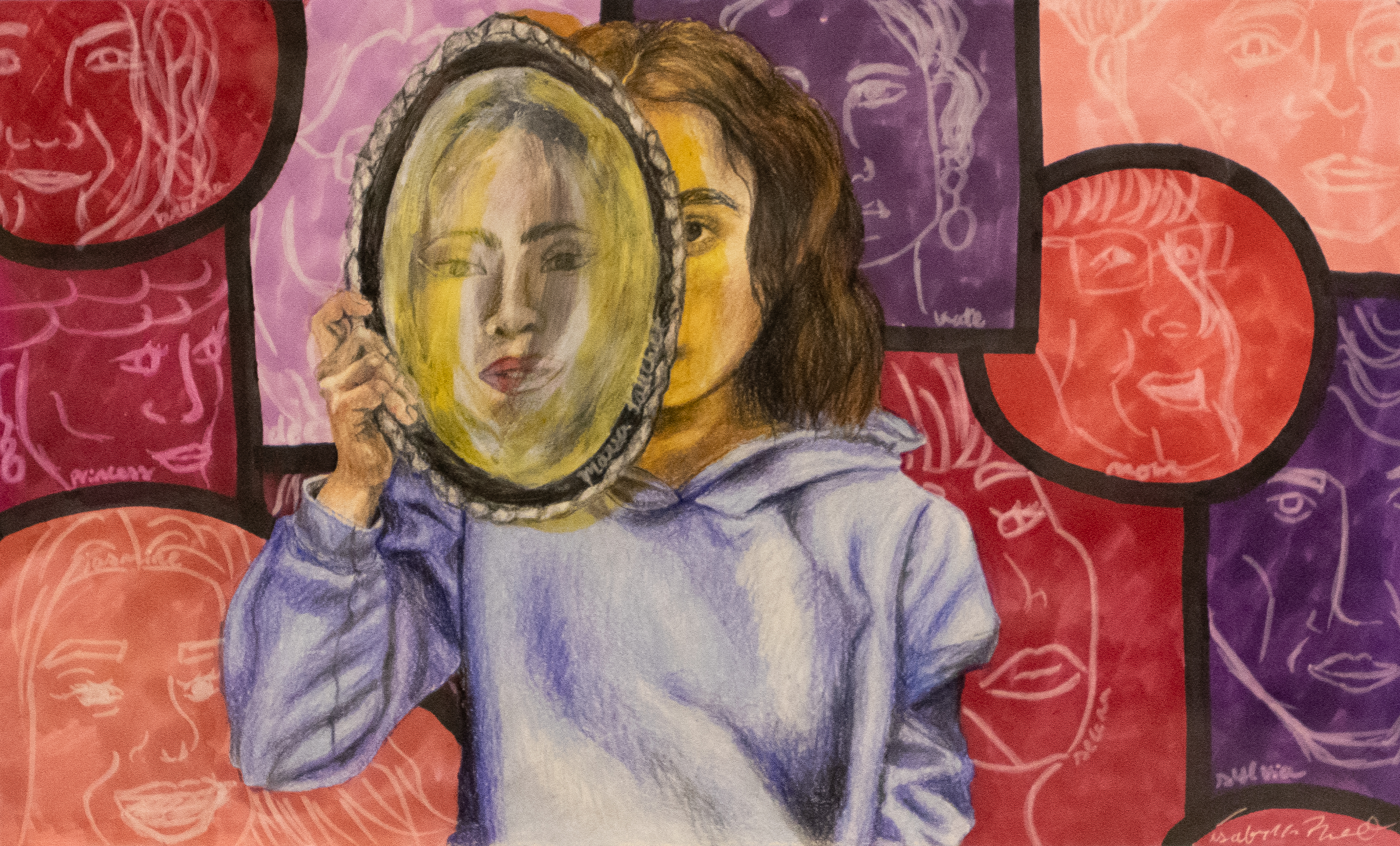
A girl in a blue sweatshirt holds a small oval mirror covering half of her face. Inside the mirror is the face of another woman, partially obscured by the glass. Behind her there are colorful pink and purple shapes with the outline of women's faces sketched onto them.
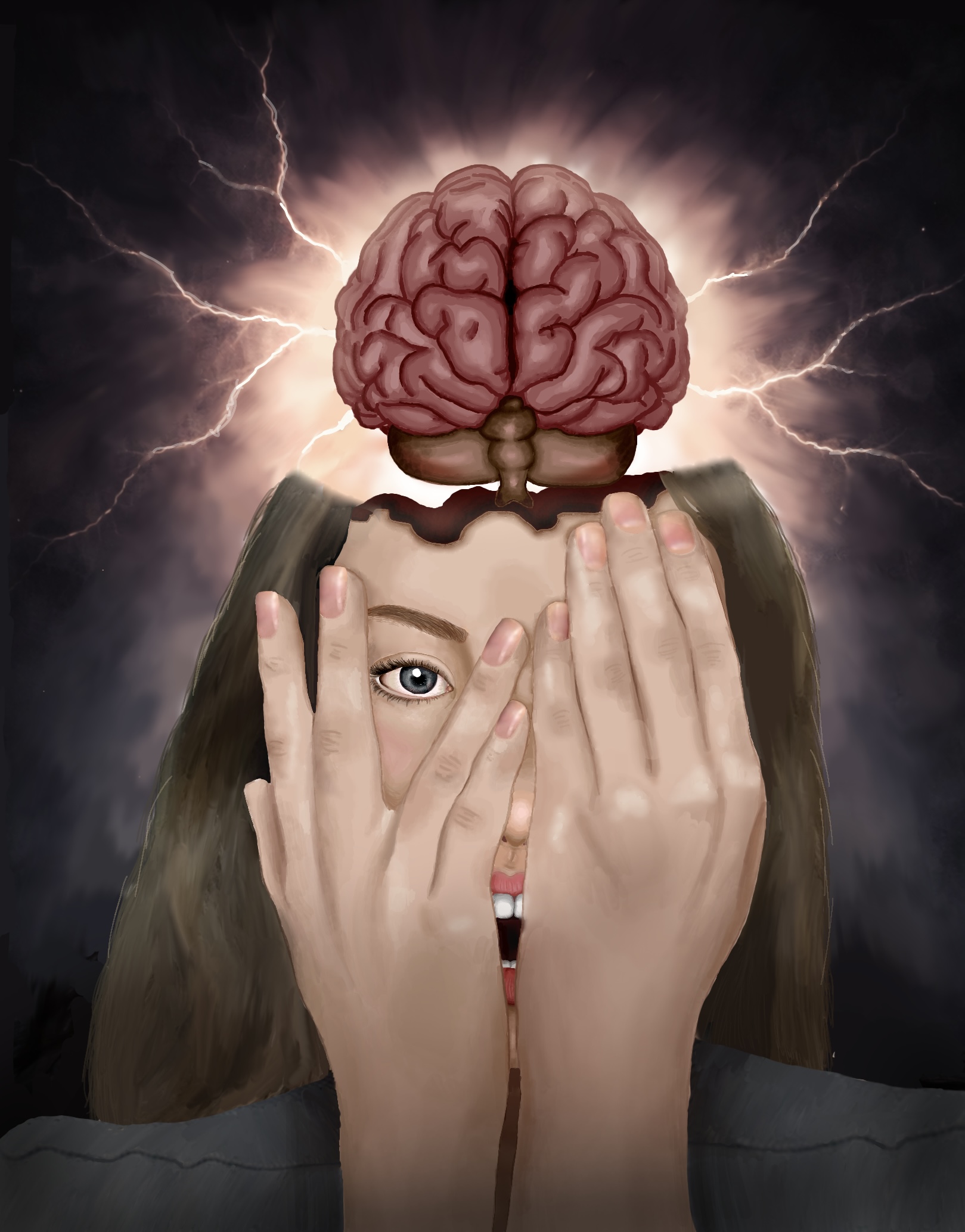
A woman shielding her face, revealing an electrified brain escaping her head, releasing in a dark, lonely space.
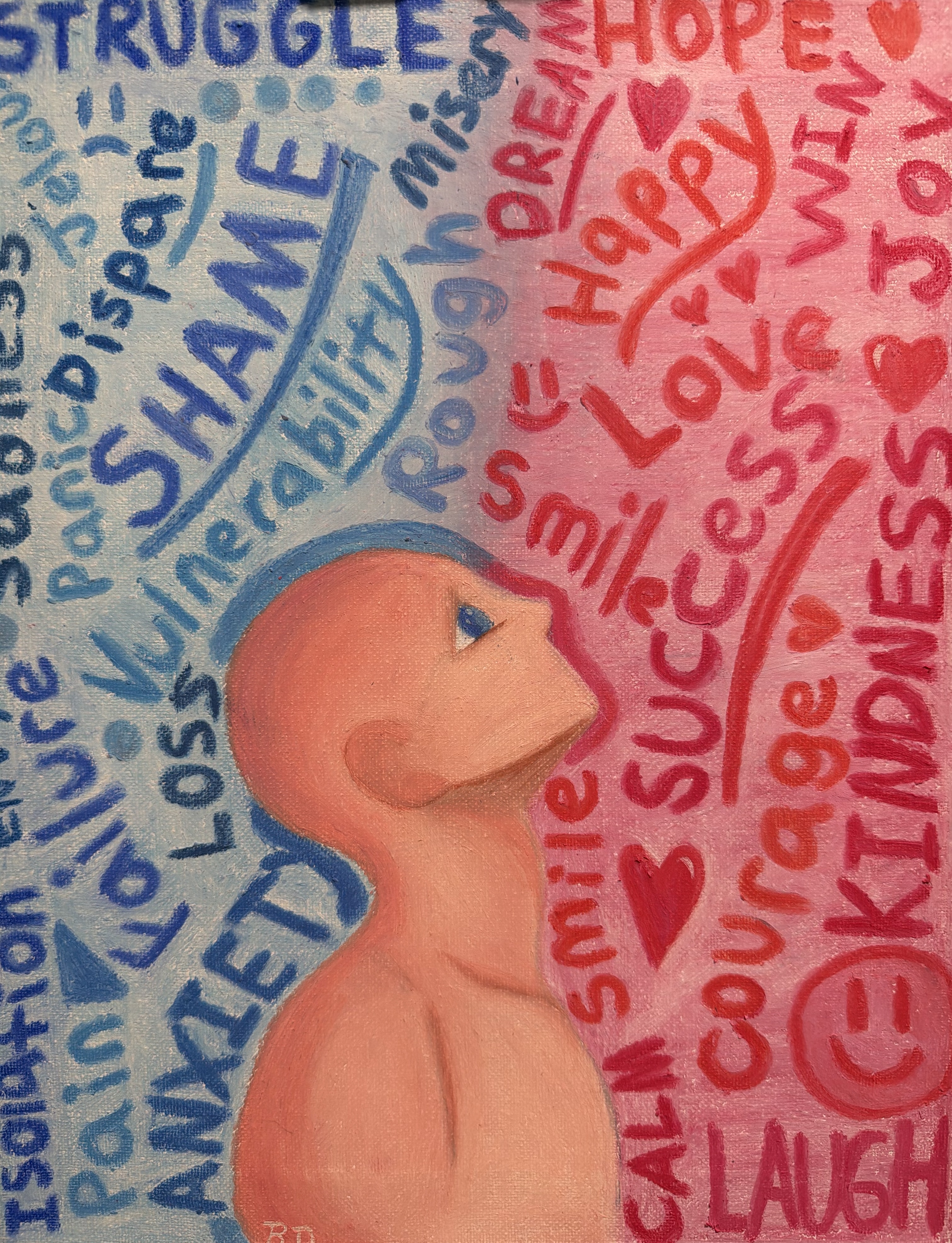
The human figure is the main focus in the middle to draw immediate attention, the human is looking up in kind of a longing way that also guides the viewers attention to the surroundings. The words surrounding the figure are not in any type of strict order, font or size, this is to allow the viewer to read and take in the meanings on their own.
Soundscapes and Neurological Processing – An Immersive Experience for Neurodiversity (Hannah Thomas)
Inspiration: “Throughout my life in Metro-Detroit I have had the privilege of growing up with a diverse exposure to a wide variety of music. I found a safe space within mixing music as a woman with ADHD, it became my slice of heaven.”
Links: Set 1: MixUzz; Set 2: JussPlayin
Sounds of the Room-
By Megan Frame
Artist Inspiration:
“Since 7th grade I have struggled with Misophonia, a condition that causes me to have adverse reactions to certain noises. This poem describes my physical reaction to noises as well as my social anxieties that comes along with it.”
Sounds of the Room
Sounds they burn
Like a knife in the head
Tears bleed from my eyes
The moments I dread
The quiet of my room
My only place of rest
Inside these walls
A weight lifted off my chest
A life of abnormality
Makes the pain seep deep
Twitching and turning
At every peep and squeak
What’s nothing to them
Is everything to me
Sounds stinging my head
Like a busy bee
Plugging my ears
Knuckles turning white
Dozens of eyes stare
At the humorous sight
Shivers down my spine
Rattling like a snake
Tics like a soda can pops
They see a fake
Sounds they burn
Like a knife in my head
Tears bleed from my eyes
And one day I hope
There are no moments to dread
Set Free
By Arija Spielberg
Artist Inspiration:
This poem captures the daily battle of living with an invisible illness.
Set Free
The spiral in my stomach,
the butterfly that has been caged.
Pressing on my insides yelling –
let me roam away.
I hate this feeling,
inside and out.
But you don’t look sick they say,
you're moving about your day.
Your playing soccer
and such a talker.
Good job you look great,
you deserve to celebrate.
I don’t want to look great
I want to feel awake,
how do I feel at ease
to let the butterfly roam free,
when it’s an anomaly.
To heal the gut inside and out,
hear what it needs
see how it breathes.
Let the butterfly speak
and maybe it will set you free.
Listen to your body they say,
listen to the butterfly
and maybe it will reach the sky.
Broken
By Jessica Iekel-Johnson
Artist Inspiration:
“My poem is about my experience growing up as an undiagnosed autistic person, how it’s impacted my friendships, my struggle to feel included, and finally understanding who I am.”
Broken
I never had very many friends growing up. I was like a bee to some degree, meddling around but never quite settling down.
I was a parasite, attracted to one person, I found myself latched onto one friendship at a time, but there was no rhyme or reason to why they would end and unzip.
I tried to have friend groups, but I never quite felt like I fit. They were always just out of reach, brushing the edges of my fingers and lulling me in before crushing my hope and I could never quite stick in their perfect little clique.
I never knew why nothing could fix me and why everyone seemed to play tricks on me.
I was still the outcast, no matter who you asked, I was just a shy kid who skirted around the edges, inserted themself into the ground but never grew roots, just blew away in pursuit of something new. I knew I was different; way back in the depth of my mind I needed strength to find my people and not just fall in line like the rest of them and be some sort of sheeple.
No matter what it was, the effect was I could never quite connect, I was a rock, too worn down by the world for them to mourn, instead eroded and left tumbling down, crumbling around the edges until I exploded.
I always thought that being alone was easier than testing the unknown, that if I deserved friends why couldn’t I conserve their ends? I thought that it was me, that I was broken or defunct, destined to never be invested in, to spend my life in a solemn mood living in solitude.
It took me a long time to realize it wasn’t me, and it wasn’t them, but just a world that tried to condemn me. And suddenly I heard about this word to describe my life and soon it was inscribed into me with a knife, a fundamental concept to describe my identity that wasn’t just me being an entity.
But when my vocabulary expanded by one, my understanding dropped down to none. Everything I thought I knew about myself turned out to be nothing more than ideas, written and forgotten on a high shelf. I was complete, not some loose form of a person but a concrete, reformed, insertion into the world
And it took time, and there’s still so many things unknown, but every day since then, I’ve grown and I know the thought train going through my brain.
I am not rude when I don’t know what people mean, I just can’t match the mood because the message is hidden in between layers of words stripped of their tone and all I can hear is fragments of sound I can’t make sense of and while everyone else is laughing along, I am laughing alone.
I’m not taking direction by sharing my stories placed in parallel with yours, I am making a connection because you’re not alone and I’ll tell you why if you’d give me a chance, if I could just make you believe that that’s happened to me, too, and break you from your trance.
I’m not trying to abandon you when I need space, I am trying to handle myself in case I implode when the walls close in from all around me, pressing down until I can’t breathe or even make a sound. The silent world, a violent whirling inside me, sending me into a never ending spiral of your denial.
And that word is more than just some characteristic, it is my journey as I learn to be proud.
I am autistic.
And I am worthy and will say it aloud.
Worthy of friends who know I am not their token or something they can crack open.
Friends who know that inclusion is not just the opposite of exclusion, it is our active role in being a whole.
Friends who dare to stand by me even in despair.
Friends who see me to my fullest degree.
Because day after day, even when the world tries to build me back, they will not fix me because there’s nothing to fix, and when the world tries to tear me down, I will not break because I am not broken
measures of silence.
By Emma Pinson
Artist Inspiration:
The why behind my piece is more than just wanting to discuss my hearing loss journey. For me, my journey is something that I hold very close to me, and honestly, writing about it has always been an excellent space for me to feel all the emotions that come with my experience and reflect on them. This piece was thus intertwined with other pieces I wrote throughout the last couple of years, along with new writing that I have added to it. I wanted to not only share my story, but also show from lived experience the reality of disability, which, at least for me, has not been a linear experience. I wanted to highlight the complexity of my life with a disability, while also reflecting on my growth and the positivity that has ultimately come from my experiences.
measures of silence.
I was only fifteen.
I was fifteen, enjoying the summer after my sophomore year, when my biggest concerns were school schedules and college dreams. When my body was something I trusted.
I was fifteen when a double ear infection changed the entire course of my life.
I was fifteen when I became 1 in 100,000, diagnosed with autoimmune inner ear disease.
I was fifteen when doctors told me I was rapidly losing my hearing.
At that moment, the world stopped, as if its axis had forgotten to spin.
“Don’t worry,” they said.
“We can get it back.”
And for a while, they did.
7,300 milligrams of prednisone, hundreds of milligrams of methotrexate, infusion after infusion after infusion.
Hope measured in dosage amounts.
You see, steroids can give you your hearing back.
But people rarely talk about what they take.
They do not tell you that hunger becomes constant. Not normal hunger. Not skipping lunch hunger. A deep, relentless emptiness that no amount of food quiets.
They do not tell you your face may become unfamiliar. That one morning, you may look in the mirror and see swelling where your cheekbones used to be. That your body may change faster than your mind can accept.
They do not tell you how hard it is to feel like yourself when you’re a sixteen-year-old girl who no longer recognizes herself.
I remember homecoming.
Wanting to look normal. Wanting to feel like everyone else, taking pictures and laughing on the dance floor.
Instead, I saw weight I did not ask for. A face I did not know. A body fighting a war I never volunteered for.
Yes, the steroids helped.
But at what cost?
So, I stopped.
To me, it was simple. I wanted to feel like myself again.
To everyone else, it was unthinkable.
My family was afraid.
My doctors were cautious.
Everyone had opinions.
But they were not the ones living inside my body.
They were not the ones feeling hungry every second.
They were not the ones avoiding mirrors.
They were not the ones trying to balance hearing and identity at sixteen years old.
Within two months, the hearing I had kept stable had disappeared.
I knew it might.
But I still chose myself.
Then came the infusions.
Once a month. Four hours. A small needle. A quiet kind of hope.
They worked,
For a while.
I learned something important during that year: doctors are not just one thing. Some were good. Some were bad.
Some were frustrating. Some felt clinical. Some spoke about my ears like problems to solve rather than parts of a person.
And some were extraordinary.
Some listened.
Some explained.
Some treated me like a partner in my own future.
I learned to advocate for myself in exam rooms before I was even an adult.
I learned how to ask hard questions.
I learned how to hope carefully.
But then the medicine stopped working.
Much sooner than anyone expected.
My body adapted. The disease adjusted. And once again, the sound began to fade.
College was supposed to be a beginning.
Instead, it became another turning point.
Within my first months at eighteen, my hearing began to decline rapidly in my right ear. Treatments stopped working the way they once had. Numbers on audiograms dropped faster than I was emotionally prepared for.
Over 70 decibels gone in months.
I was no longer imagining the future.
I was watching it happen in real time.
I was scared.
I wasn’t scared of losing my hearing, though. I was scared of isolation.
People often imagine hearing loss as silence. These people are wrong.
Hearing loss is effort. It is exhaustion. It is constantly calculating:
Did I hear that right?
Are there captions available?
Should I ask them to repeat?
Is an ASL interpreter available?
Is it worth the interruption?
Will they get annoyed?
Sometimes the hardest part was not strangers.
It was the small moments at home.
Family members forgetting I couldn’t hear without my hearing aids. Conversation continuing without me. People talking while looking away.
People overcorrecting. Over-enunciating. Turning my disability into something performative instead of practical.
I did not need yelling.
I did not need announcements.
I needed three simple things:
Look at me.
Speak slightly clearer.
Repeat or rephrase when needed.
And most importantly:
Let me speak for myself.
Acknowledge my hearing loss, it’s part of who I am,
But it is not my entire identity.
Include me. Do not manage me.
There is a difference.
Then somewhere during that year, the conversations changed.
At first it was Let’s try another steroid course
Then it became Let’s adjust your medication.
Then Let’s see what the next labs show.
And then one day it became We should start talking about cochlear implants.
Not today. But someday.
Someday if hearing dropped another 30 or 40 decibels.
Someday if hearing aids stopped being enough.
Someday if understanding speech became more guessing than hearing.
I nodded like I understood.
Like I was ready.
Inside I was doing the math.
Permanent. Irreversible. I’d be saying goodbye to all natural hearing I once had.
Some people say that cochlear implants restore hearing.
They don’t.
They change it.
They offer access while asking you to let go of what could be.
I realized something difficult. At some point, I would have to choose. Not between hearing and deafness.
But between access and endless treatment.
Between fighting a seemingly hopeless battle and living my life.
Between more medicine… or more happiness.
I would have to choose whether I wanted to keep chasing small pieces of natural hearing through medications that made me feel like I was disappearing, or choose technology that could give me stability.
I would have to choose myself.
And that felt, at first, like giving up.
Giving up on my natural hearing.
Giving up on the idea that maybe one more treatment would fix everything.
Giving up on the version of my life I thought I would have.
But what I slowly began to understand was this:
I was not giving up.
I was choosing a life where I could recognize myself again.
I was choosing stability over uncertainty.
I was choosing access over exhaustion.
I was choosing happiness over survival mode.
And maybe the hardest part was learning that choosing yourself can feel selfish when you have spent so long trying to be strong for everyone else.
But it wasn’t weakness.
It was the first decision that was fully, unapologetically mine.
After losing my hearing, I found that people expected me to grieve conversations. To grieve voices. To grieve the ease of listening.
But what I grieved most was music.
I don’t play an instrument. I don’t sing.
So, honestly, that grief surprised me.
Like any teenage girl, I’d blast my car radio while driving at night, turn my speaker to its highest volume while doing my laundry, and sing with my friends while getting ready.
But I loved music.
I loved listening to it loudly, letting the beat move through me, with lyrics living somewhere deeper than sound.
Now music felt different.
Not bad.
Not empty.
Just… different.
And different can hurt.
I will hear music.
But never hear it the way I once did.
A natural ear hears through thousands of hair cells.
I would hear through twenty-two electrodes.
Improvement. But not restoration.
That realization was not frustration.
It was grief.
After surgery, the cochlear implant activation day did not feel like a miracle.
It felt like a beginning.
The sound was not amazing. The sound was not terrible. It was just different.
Voices sounded unfamiliar. Tones felt mechanical. My brain had to relearn what it once understood effortlessly.
But something remarkable happened. My brain adapted.
Slowly, sound became less foreign.
I began appreciating progress instead of perfection.
Different did not mean worse.
It meant learning again.
Along this journey, something else changed, too.
I met Deaf friends.
People who did not see silence as something tragic.
People who taught me things no medical appointment ever could:
That deafness also means community.
That communication can be visual.
That rest from sound can feel peaceful instead of frightening.
I started taking hearing breaks.
Taking my devices off and realizing that quiet was not always something to fear.
Sometimes silence was relief.
Sometimes silence was control.
Sometimes silence was mine.
I began learning ASL. While at first is felt like survival, now it feels like expansion.
Another language.
Another community.
Another way of existing in the world.
I stopped seeing deafness as only something being taken from me.
I started seeing what it was also giving to me.
Now I am nineteen. And I am preparing for my second cochlear implant.
People sometimes hear my story and assume this is a sad ending, responding with “oh, I’m sorry you had to go through all of this.”
And I understand why they say it.
On paper, it does look like loss.
But what they don’t see is that this is not just a story about losing hearing.
It is also a story about gaining perspective.
About learning how strong a person can become when they are forced to rebuild parts of themselves earlier than expected.
About realizing that deafness is not just something that took from me.
It also gave me things I never would have learned otherwise.
It gave me advocacy.
It gave me resilience.
It gave me community.
It gave me a completely new way of understanding communication, effort, and inclusion.
Sometimes I even think of it as a kind of superpower.
Not because it’s easy.
Not because I would have chosen this path.
But because it has forced me to see the world in ways many people never do and seek change.
I notice accessibility.
I notice when someone is left out of a conversation.
I notice when someone takes the extra second to include someone else.
I notice the effort.
And I advocate now.
Not just for myself, but for others who should not have to carry the burden of asking for access that should have existed all along.
I speak up.
I explain.
I educate.
I push for access because I know what it feels like when it isn’t there.
But I also believe this:
People should not have to lose something to understand accessibility.
People should not have to become disabled to notice exclusion.
And people with disabilities should not have to share their hardest experiences just to prove that access matters.
Access should already matter.
No one owes the world their story just because they are disabled.
Some people choose privacy.
Some people choose not to explain.
And that choice deserves just as much respect.
I share my story because I want to.
Because I am comfortable doing so.
Because if my experiences make the path even slightly easier for someone else, then the vulnerability feels worth it.
But this is my choice.
Not my responsibility.
And that distinction matters.
And I am happy.
Not because everything turned out the way I once imagined.
But because I have found stability in a life that once felt uncertain.
I am choosing access.
I am choosing consistency.
I am choosing a version of hearing that allows me to keep building the life I want.
I am still Deaf. That doesn’t change. I may be Deaf with a cochlear implant, but I am Deaf.
And yeah, there are times when I may feel like I once did.
That’s maybe the most honest thing I can say about my experience with a disability:
It is not one emotion.
It is frustration and pride.
It is grief and gratitude.
It is fear and strength.
It is loss and discovery.
I am not the person I was before I lost my hearing.
But I am also not someone to feel sorry for.
I am someone who learned how to adapt. Someone who learned and continues to learn how to advocate. Someone who learned that happiness does not always look like what you originally planned.
This second implant is not the end of my story.
It is not something that happened to me.
It is something I am choosing.
It is the beginning of a new chapter.
One where sound may be different.
But where I am finally learning that different does not mean less.
Sometimes it just means new.
The Double Empathy Problem
A neurodivergent phenomenological prose poem
By Riley Clark
One morning I asked you how you made friends so naturally that so many people consider you close to them. Then I asked you why would you even want that? "Don't put all your eggs in one basket" was your response. The conversation ended at that and I still couldn't fully grasp your perspective, but I felt something thorny catch in my chest- jealousy.
Why couldn't I be like that?
Everything I've ever done, I have focused all of my heart and soul onto. To me, that's all that makes sense. Why commit to something if you aren't going to follow all the way through?
Still, I see the appeal in diversifying my options, if one fails then you'll always be safe in a way. I can't imagine living without the fear that the handful of things that I care for won't last or continue to bring me the same unbridled joy.
That fear is inseparable from how much care is associated with each aspect of interest for me, so that nothing can alter it in my mind.
If I could measure and control the variables in my life before acting upon them, I would. The truth is that routine and returning is what love is for me.
I was supposed to understand what you were feeling, so that I could put an end to what was hurting you. Was it me that was taking your life back away from you? "The problem is that you don't already know what's wrong." I must be missing something here. The urgency ticks faster in my ear as I face the consequence of not knowing what I'm supposed to know. Every moment spent pondering the hidden double meanings in the pointed remarks- every remark you make feels pointed. If I need to convey unease, I must decode the inhibitions just to re-encode them into more puzzles to be pondered but never solved.
My need to be as precise and accurate as possible resulted in monologues of my emotional state and thought process. The reason I explained myself in this way was because I felt that being that explicit meant I couldn't possibly be misunderstood, but I was wrong. It turns out the more that you actually say, the more there is to be misinterpreted by the listener. My thought processes spoken aloud read as retroactive justifications for the harm that I caused because of how meticulously methodical they were in nature. I didn't know then what someone else might want in an apology because to me, a logical explanation is what helps me to make sense of what transpired and why. Only then can I unravel the root of the issue, and work collaboratively towards a solution for the relationship. If I didn't understand in what way I had hurt someone, I couldn't truly be sorry because I didn't have the full picture for how to change my behavior and why.
I could see the exhaustion weighing on your demeanor, in your restricted affect. I was being met where I was like clockwork, and failing time and time again to come through in the way that you needed me to. There was no shortage of space holding and reassurances to help ease my pain, but that isn't what I needed to feel stable. For as much as I explained my side of things, it never seemed to be understood. Your confusion and frustration became a silence on the other line, a slew of confessions followed by a deafening absence of sound.
As the instability grew, I leaned more heavily on the simple routines that defined our relationship to me. If I stopped speaking entirely, maybe I could rest. Formerly focused on long-term solutions, I just wanted something that felt warm for a little while.
So I detached physically from my concern and I carried out the motions that I knew could not be misinterpreted as anything but affection- which led to further confusion. My body became a vessel for the ending we both knew was coming, and I watched myself horrified. The routines that I had once treasured became hell to me. There was nothing left now, and I lamented my lack of baskets.
Artist Inspiration:
To experience this piece as intended, it is highly recommended that the poem is read prior to reading this artist’s statement.
This prose poem functions as an autopsy of a relationship examined through a neurodivergent lens. Inspired by Dr. Damian Milton’s theory of the Double Empathy Problem, the work posits that breakdowns in communication between individuals with differing neurotypes are reciprocal translation errors rather than individual deficits (Milton, 2012). This framework is grounded in research by Dr. Catherine Crompton, whose work on same and mixed neurotype interactions demonstrates that Autistic-Autistic pairings communicate as effectively as Allistic-Allistic pairings, while Autistic-Allistic pairings perform significantly less effectively and report lower levels of rapport (Crompton et al., 2020).
As an AuDHD (Autistic and ADHD) academic, I have intentionally structured this piece to mirror my internal experiences with code-switching, autistic masking, and my specific cognitive and empathic processing styles. The text is designed to pull the reader into the narrator’s perspective, inhabiting the uncomfortable state of being misunderstood while experiencing the profound energy drain inherent in communication misalignment. By recreating my genuine inner monologue, I seek to provoke a response of either frustration or recognition, forcing the reader to examine their own biases. In this way, the act of reading becomes a microcosm of the Double Empathy Problem itself.
Despite the bleak tone of this prose poem, research is beginning to suggest a genuine hope for mixed-neurotype communication. A recently published article on Communication Partner Training (Albin et al., 2024) identifies three essential components for closing these relational gaps: a deep knowledge of the partner’s communication profile, an adaptation of the communication environment, and the creation of collaborative strategies unique to the pairing.
The key to bridging this divide lies in both individuals intentionally maintaining an open mind regarding how others perceive the world, treating these differing views as equal to their own. This requires a commitment to curiosity regarding a partner's communication style and personal philosophies. When both parties normalize one another's worldviews and make a genuine effort to meet in the middle, meaningful connection can be sustained. Ultimately, this work is an attempt to challenge normative views regarding autistic empathy and communication, framing both Autistic and Allistic perspectives as equally valid and worthy of understanding.
References:
Albin, M., Chawrun, I., & Tint, A. (2024). Rethinking Social Communication Support: Exploring Communication Partner training for autistic adults and their neurotypical communication partners. Autism in Adulthood. https://doi.org/10.1089/aut.2023.0181
Crompton, C. J., Ropar, D., Evans-Williams, C. V., Flynn, E. G., & Fletcher-Watson, S. (2020). Autistic peer-to-peer information transfer is highly effective. Autism, 24(7), 1704–1712. https://doi.org/10.1177/1362361320919286
Milton, D. E. M. (2012). On the ontological status of autism: The ‘double empathy problem.’ Disability & Society, 27(6), 883–887. https://doi.org/10.1080/09687599.2012.710008
Be Not Afraid of Love
By Brooklyn Cross-Eason
Artist Inspiration:
“Be Not Afraid of Love comes from my journey of unlearning what I thought love was supposed to feel like. I grew up in environments where love and pain were often intertwined, and that shaped how I viewed myself and my worth. For a long time, I believed I had to shrink, endure, or earn love in order to receive it.
The imagery of a seed represents that version of me, planted, but not always nurtured. Through this piece, I explore what it means to grow in conditions that were never meant to support you, and how that affects your ability to trust love later in life.
At the same time, this poem reflects my healing. It captures the shift from fear to understanding, from survival to growth. I am learning that love can be safe, that it can be given freely, and that I am worthy of it without changing who I am.
This piece is both a reflection of where I’ve been and a reminder of where I’m going.”
Be Not Afraid of Love
Be Afraid Be of Love
The first hands that held me
were the same ones
that pulled at my roots.
A seed was planted in the ground
I was told to grow.
But little did I know,
the ones who planted me
never nourished me.
They were a flood
when I was already drowning,
a drought
when I was desperate for rain.
Love came in silence
thick enough to swallow me whole,
in hands that once cradled me
but still found ways to
crush me.
Love was being kicked out at fifteen,
with just a jacket and a backpack,
barely enough
to keep the winter
from seeping into my lungs
until my breath
became shallow.
Love was Momma screaming,
her voice an ache in my chest,
telling me
she didn’t even want
to see me graduate
just because I went to therapy.
Love was Daddy stumbling in,
drunk,
his presence pressing down
like a heavy fog,
filling every corner
with the stale breath
of liquor and regret.
The walls hummed with tension.
The air was thick enough to choke on.
I could taste it
bitter, metallic,
the flavor of unsaid words
left too long
on the tongue.
Love was silence
and shattered trust,
the kind that clung to me
long after the door
slammed shut.
And it cost me
everything.
It cost me
the ability to love myself.
To see myself
as worthy
of the kind of love
it takes
to heal.
To accept love
from others
who saw something in me
I could not see
in myself.
I spent years
looking at my reflection
but never recognizing
the person
staring back.
So I learned
to make myself smaller
roots curling inward,
afraid to stretch too far.
I feared the rain,
because even that
began to hurt
each drop sharp as needles
against my skin,
reminding me
everything
was drowning me.
I feared the sun,
because warmth
never stayed.
It teased,
it lingered,
then it burned.
And I feared love,
because it always
came with a cost.
But healing…
healing taught me otherwise.
At first,
it was quiet
a whisper
too soft
to believe in.
But the whispers grew louder
in the voices
of those who stayed.
The ones who saw me
even when
I couldn’t see myself.
The friends who held my hands,
who called my name
and reminded me
I was still here.
The ones who didn’t ask me to shrink,
but showed me
how to bloom.
Healing was laughter
filling the hollow spaces
pain left behind.
It was learning
that love
does not have to be begged for.
I let the wind carry
the pieces of me
that were never meant
to stay buried.
I will know love
not by how tightly
it holds me,
but by how freely
it lets me go.
And as I grow
slowly, painfully, beautifully
I begin to see it now:
Even damaged roots
can heal.
Even seeds, once buried,
find their way
to the light.
You will find your way, too.
Lean toward the sun,
and you will never be lost.
At no cost
will I stop
finding my way.
Be not afraid of love,
Brook.